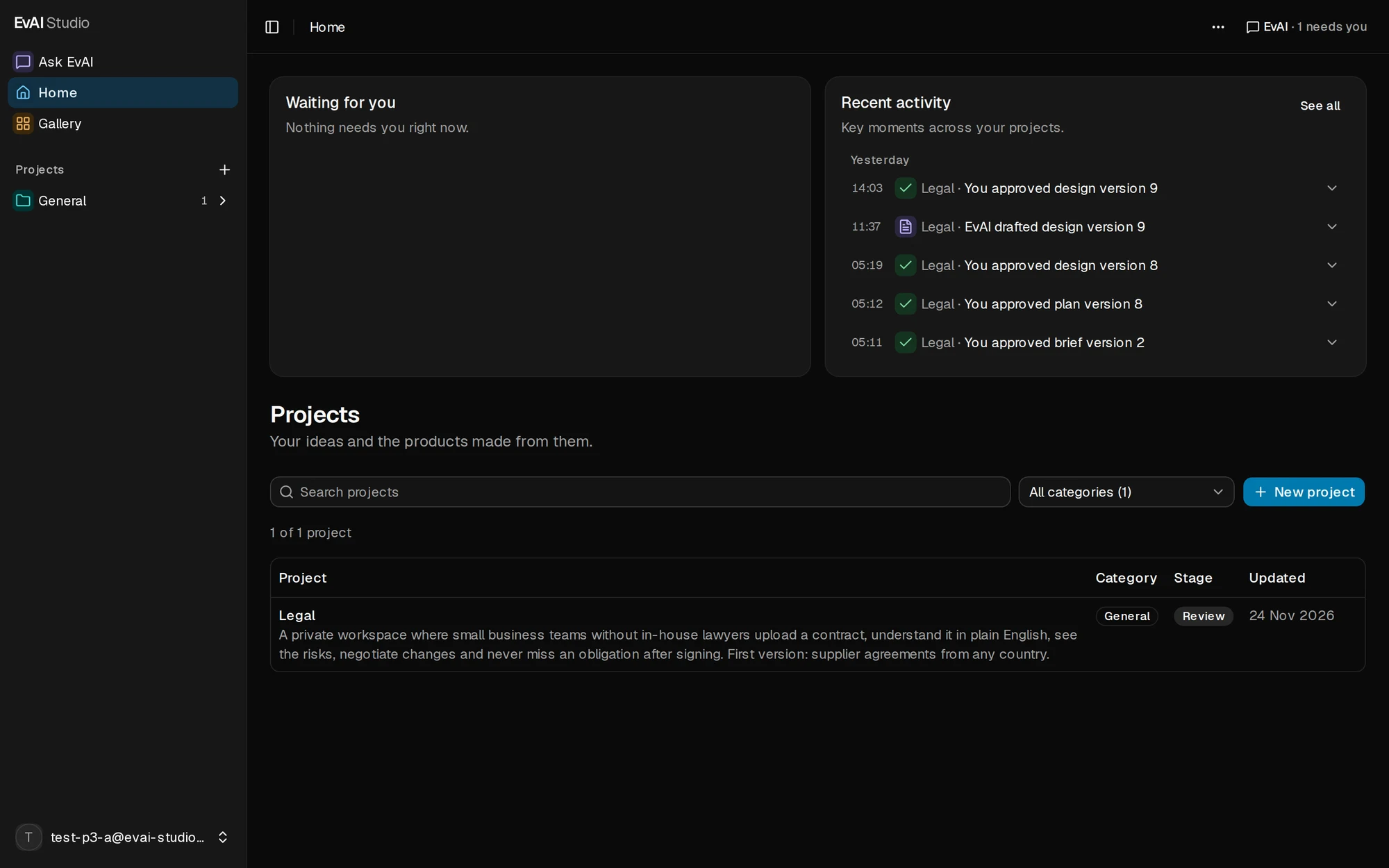
The problem
Turning an idea into a real product means juggling briefs, plans, design files, developers, testers and a dozen tools. Most people with a good idea never get past that point, and the ones who do lose decisions at every hand-off.
The idea
One place, one path. A project moves through eight stages, and each stage asks for one decision at a time. Nobody needs to understand the whole build process to keep moving.
Nothing is built until the plan is approved, and nothing ships until a person has reviewed it and signed it off.
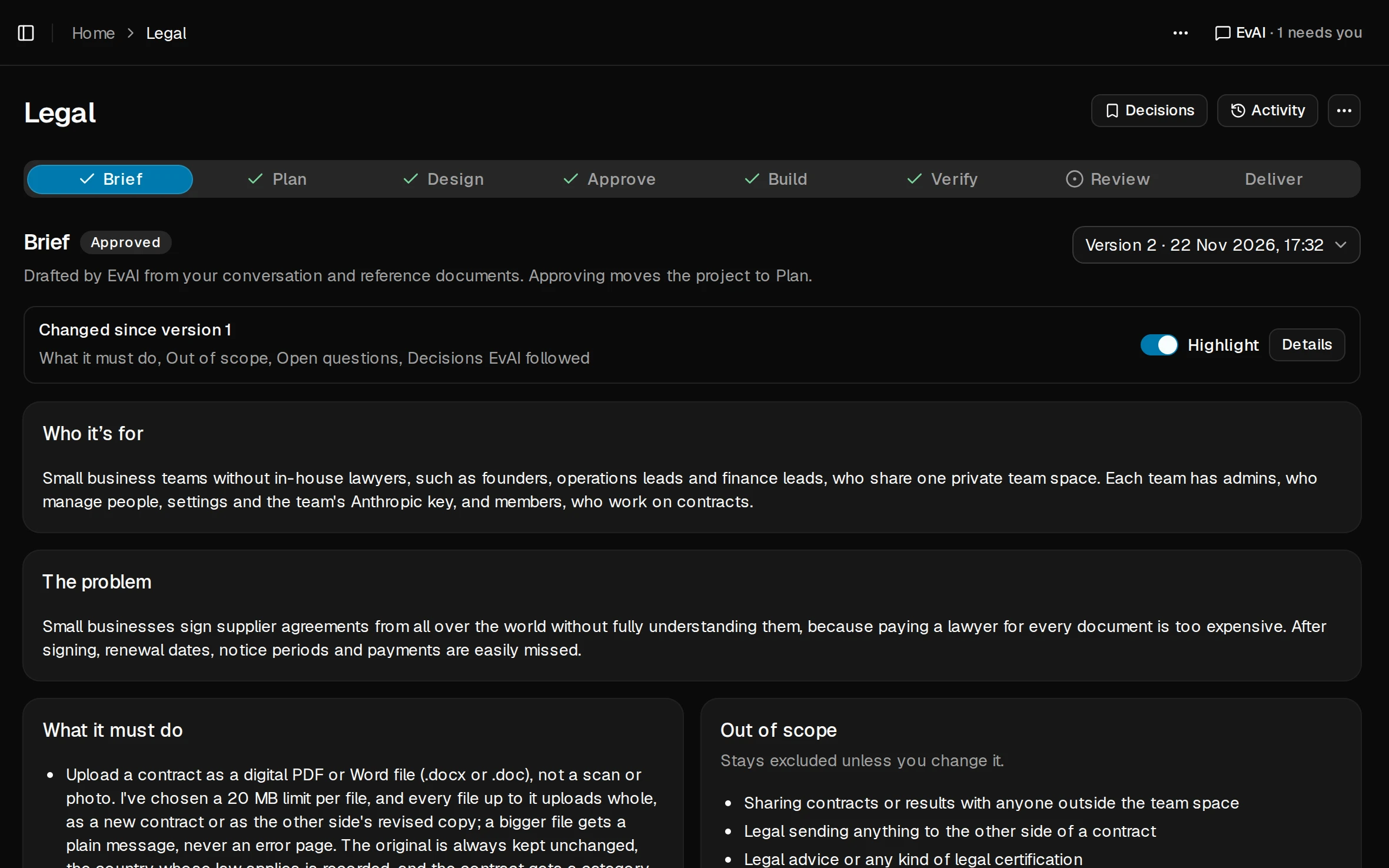
The brief, drafted by EvAI from a conversation and reference documents. Every version is kept, and changes since the last one can be highlighted.
My role
I conceived EvAI Studio and lead it as founder and product owner. I set the vision, designed the journey and the EvAI conversation, wrote the decision record and the quality standards, and lead delivery by directing AI coding agents.
How a product is made
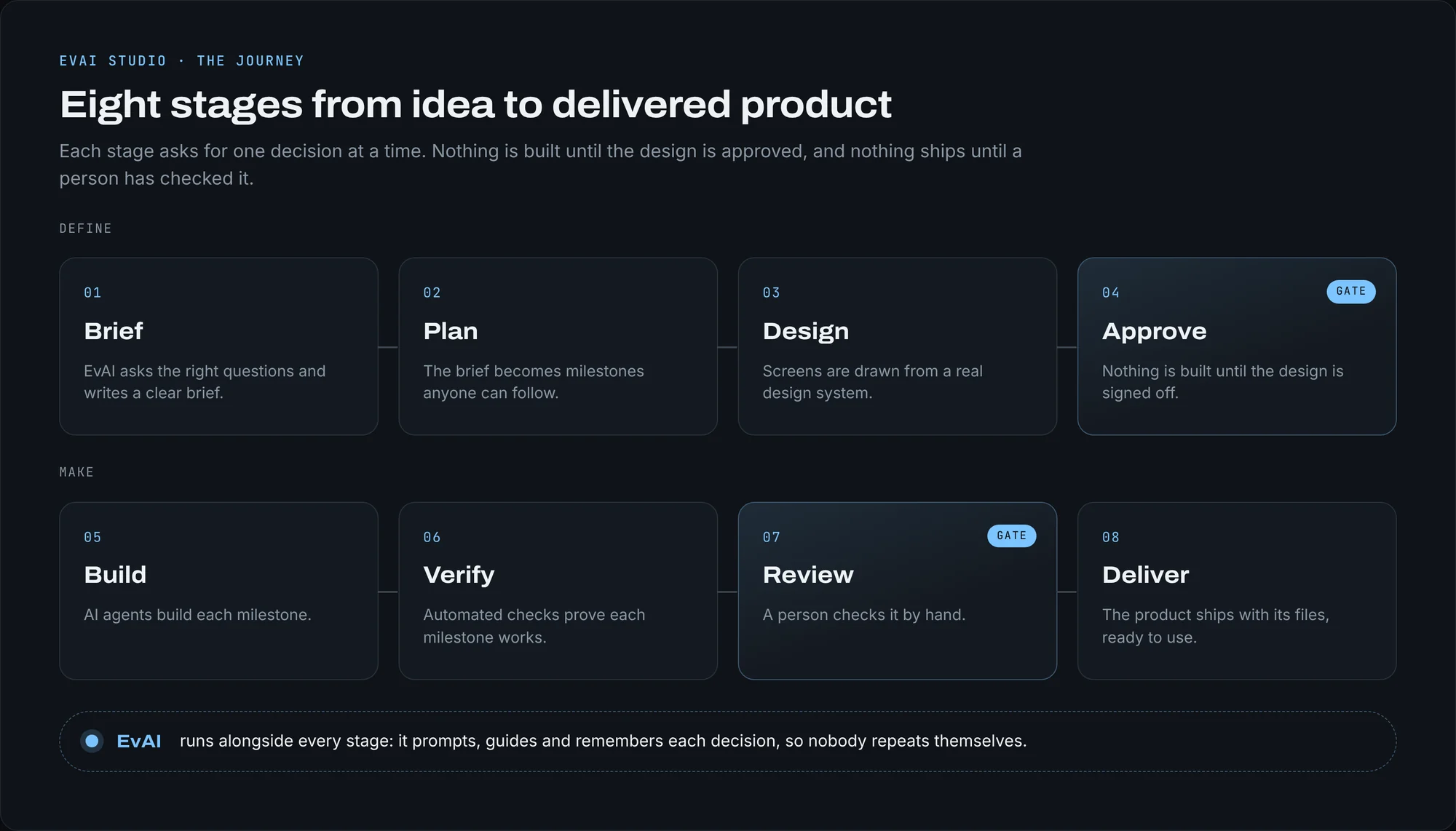
Swipe to see the full diagram →
Brief. What the product is, who it’s for and what it must do. EvAI drafts it; you approve it.
Plan. The outcome, and the milestones to get there.
Design. Every screen, drawn in the product’s own look before anything is built.
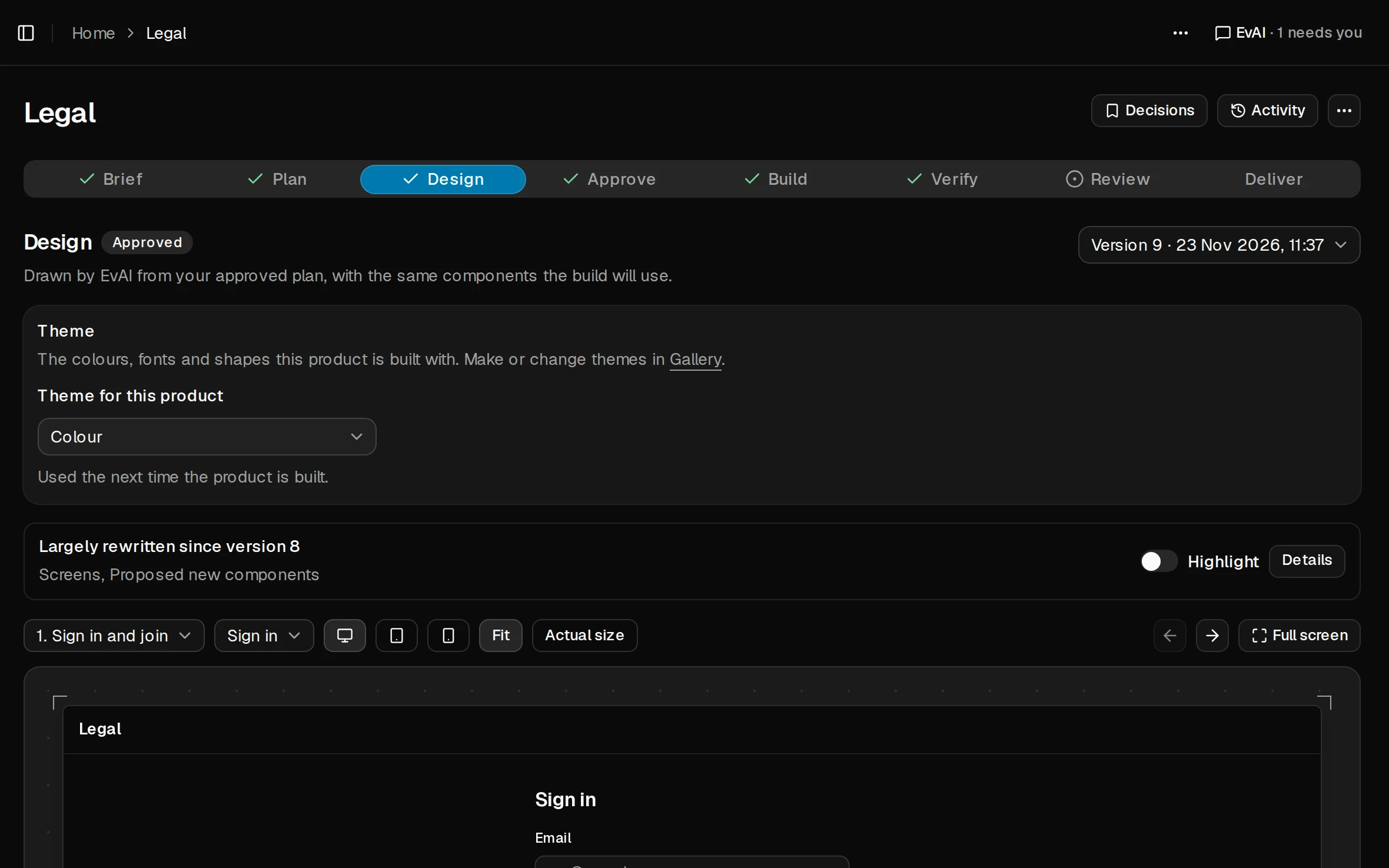
The design, drawn with the same components the build will use.
Approve. The single decision that starts the build.
Build. EvAI builds in milestones and checks its own work, pausing for you to look.
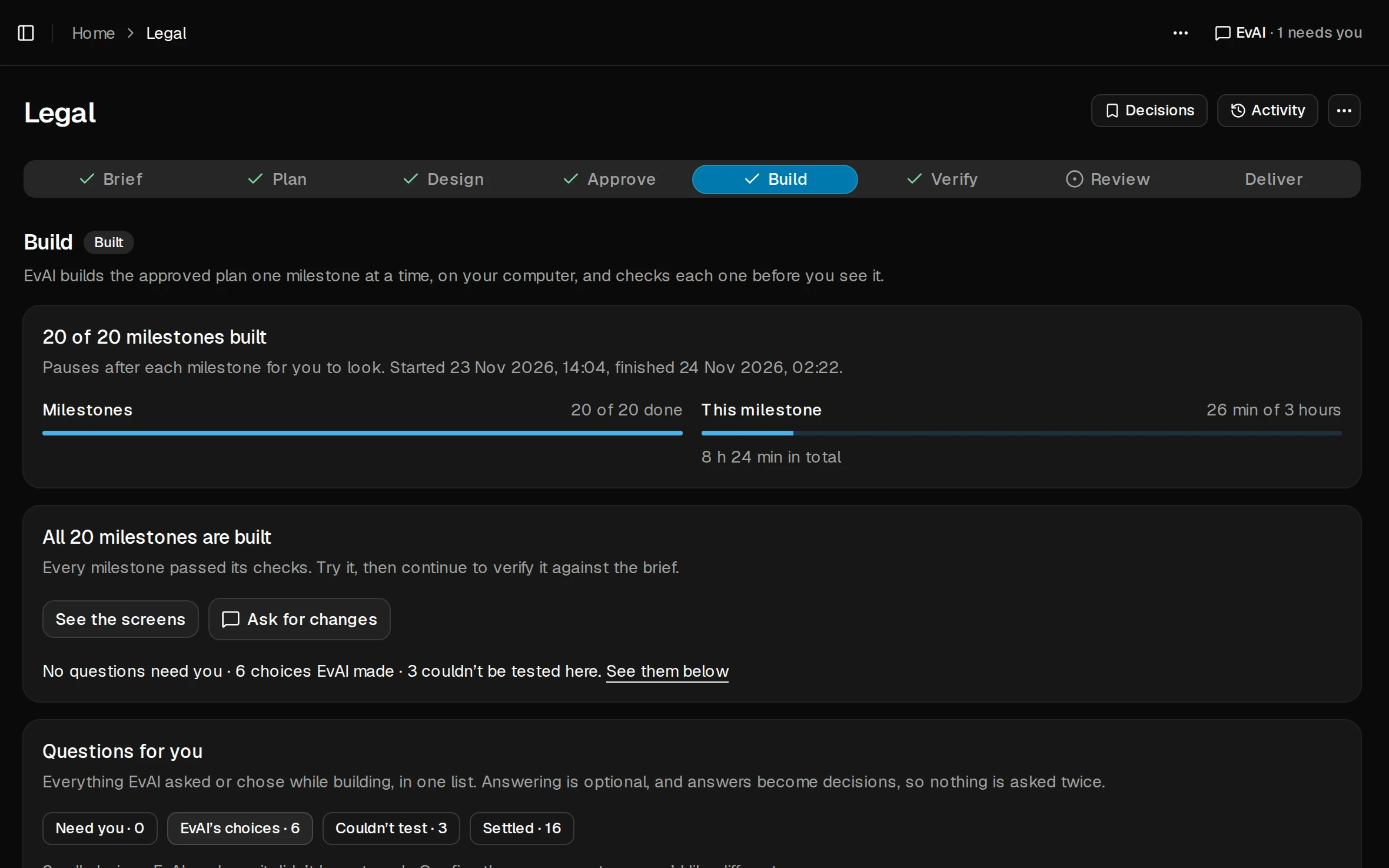
Every milestone built, with each question EvAI asked or choice it made in one list.
Verify. The finished product, checked as a whole. It reports what passed and what couldn’t be tested, and never approves anything itself.
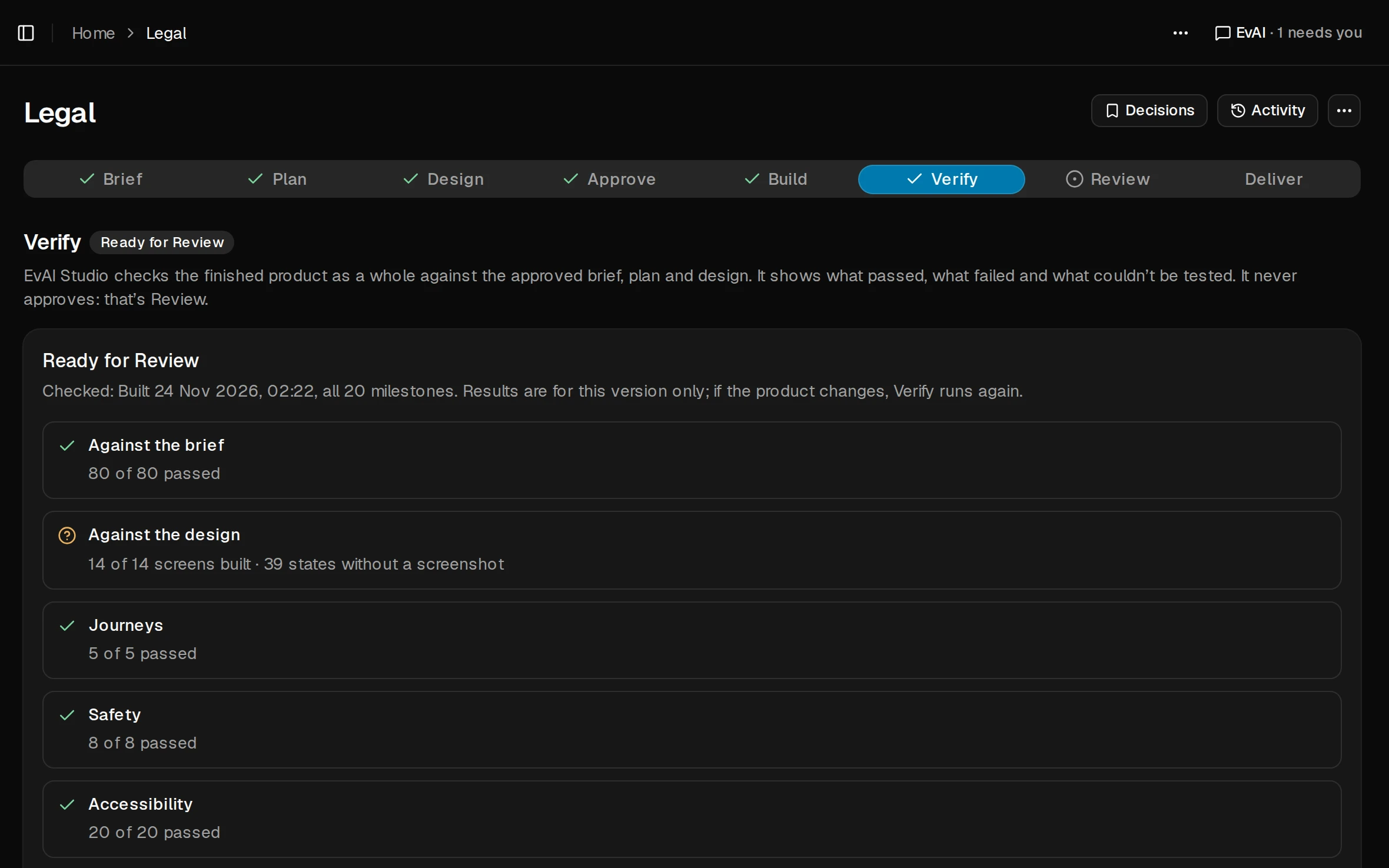
Verify reports results as they are, including what still needs a person.
Review. A person decides, and signs off the exact version.
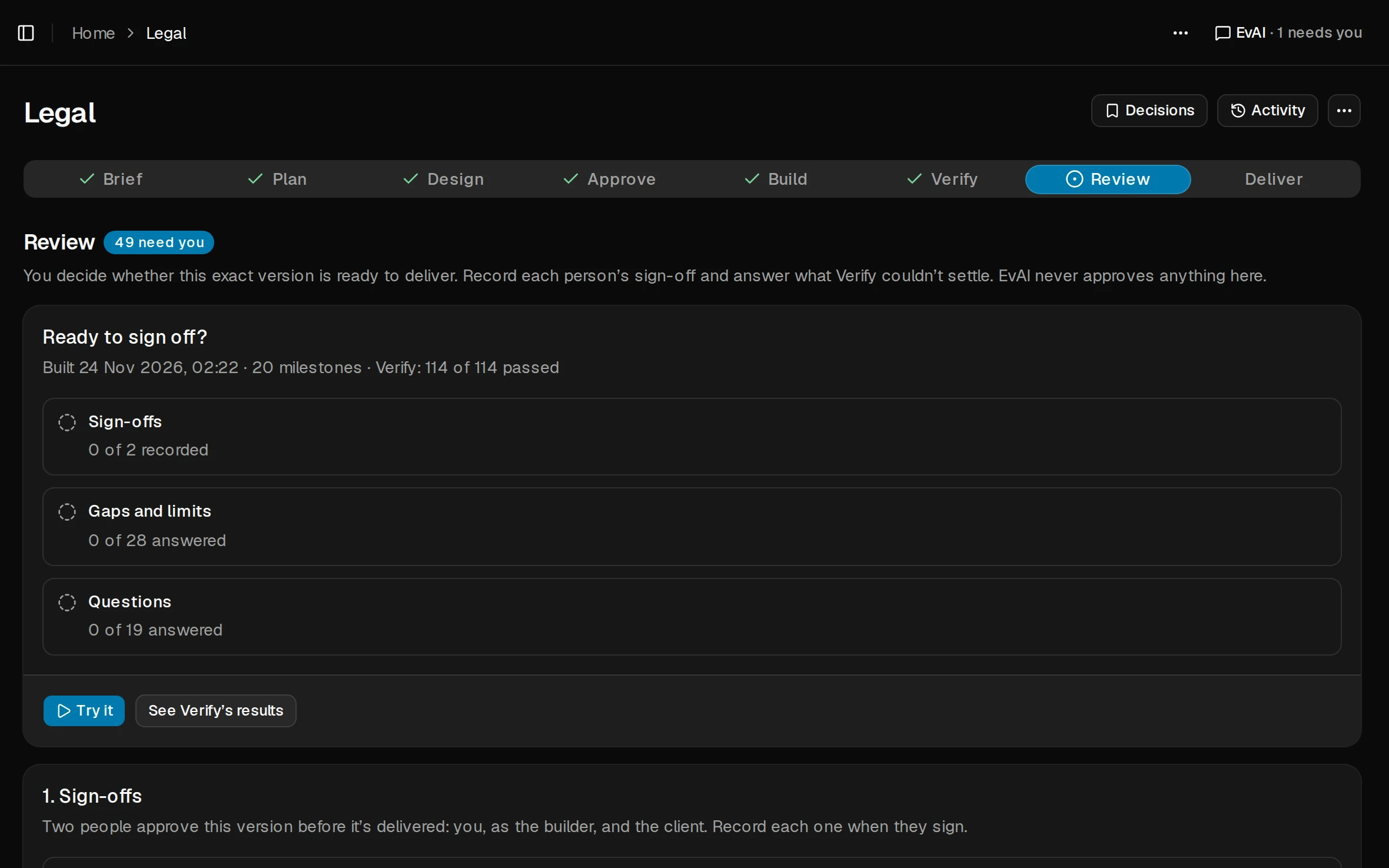
Review: try the version, record the sign-offs, answer what Verify couldn’t settle.
Deliver. The approved product, handed over with a step-by-step guide.
Building it: what went wrong, and what changed
Every version of Studio was tested by building a real product with it. Legal, a contract workspace for small businesses, was built twice. Each time I logged what went wrong and fixed the cause in Studio itself, not in the product.
- Ask once, then remember. The first Legal build asked 63 questions, some of them more than once, and answering them became a chore. The aim wasn’t simply to ask less: it was to ask once, at the right time, and never forget the answer. Questions now come together up front, each with a suggested answer, and every answer becomes a recorded decision. The second build asked 3 questions during the build, and the brief, plan and design each needed one version instead of several.
- Never quietly settle for less. When the AI couldn’t reach the model it needed, it swapped Legal’s AI explanations for fixed rules and called it a design choice. It had also invented limits nobody asked for. Now the plan names the product’s main feature, and that feature must work for real before the product passes. Any limit the AI makes up becomes a setting the owner controls.
- Honest content. The first build invented facts, including a legal system and a team of lawyers, and claimed uploads were never sent to an outside service when they were. The second build had no invented facts, and it states plainly where data goes.
- Checks passed; the product was still wrong. Every automated check passed, then a hand test with a new contract showed the key feature missing a change it should have caught. Nothing is now called checked until someone has walked through it on a phone and a laptop with realistic files.
- Screens that tell the truth. A queued check said “checking”, so it looked stuck, and empty screens made people wonder whether anything was happening. Every waiting state now says what it is waiting for and what to do. Activity shows only real events, never invented progress.
- One place for every action. Testing on my phone found buttons that moved from stage to stage, a keyboard covering text boxes and text spilling out of cards. Every stage now ends the same way, with the next step always in the same place.
- No surprise costs. An unexpected AI bill led to a simple rule. Each product runs on the owner’s existing AI subscription by default, or through an API key only when the owner chooses it.
The result
- First Legal build: 4 days 6½ hours, answering 63 questions.
- Second build: 15 hours, mostly waiting on answers or on fixes to Studio.
- A change to the delivered product: 2 hours 51 minutes, from one action, with no questions.
Building each milestone took the same time throughout. The gain came from fewer rounds, fewer questions and fewer stops, not from building faster.
EvAI, the partner inside it
EvAI is a conversation, not a form. It keeps the whole project in mind, so you never repeat yourself, and answers in plain English from the brief, plan and decisions. Beside the conversation it shows what’s running, what needs you and how far each project has come.
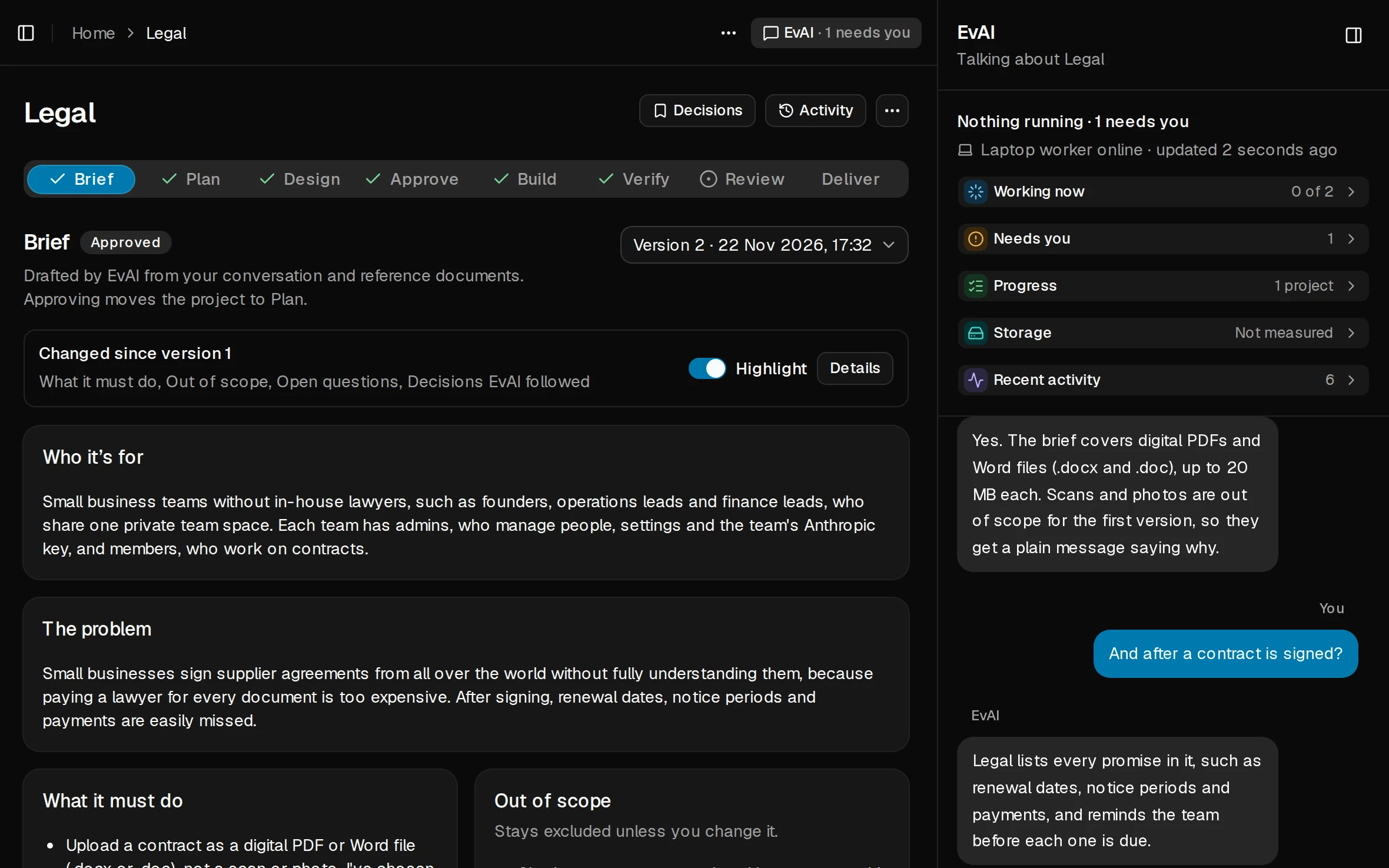
Asking EvAI about the product while reading its brief.
Principles that came out of it
- Honesty over flattering numbers.
- Decide by default, ask once, remember every answer.
- Never quietly remove or downgrade what was asked for.
- Check it yourself, on a phone, with real data, before asking anyone else to look.
- Every promise about cost or safety becomes a check, not a sentence.
- Every mistake becomes a lesson; a repeated lesson becomes a check.
The Gallery
Everything Studio builds comes from one design library of components, layouts, patterns and themes, shown running live in the Gallery.
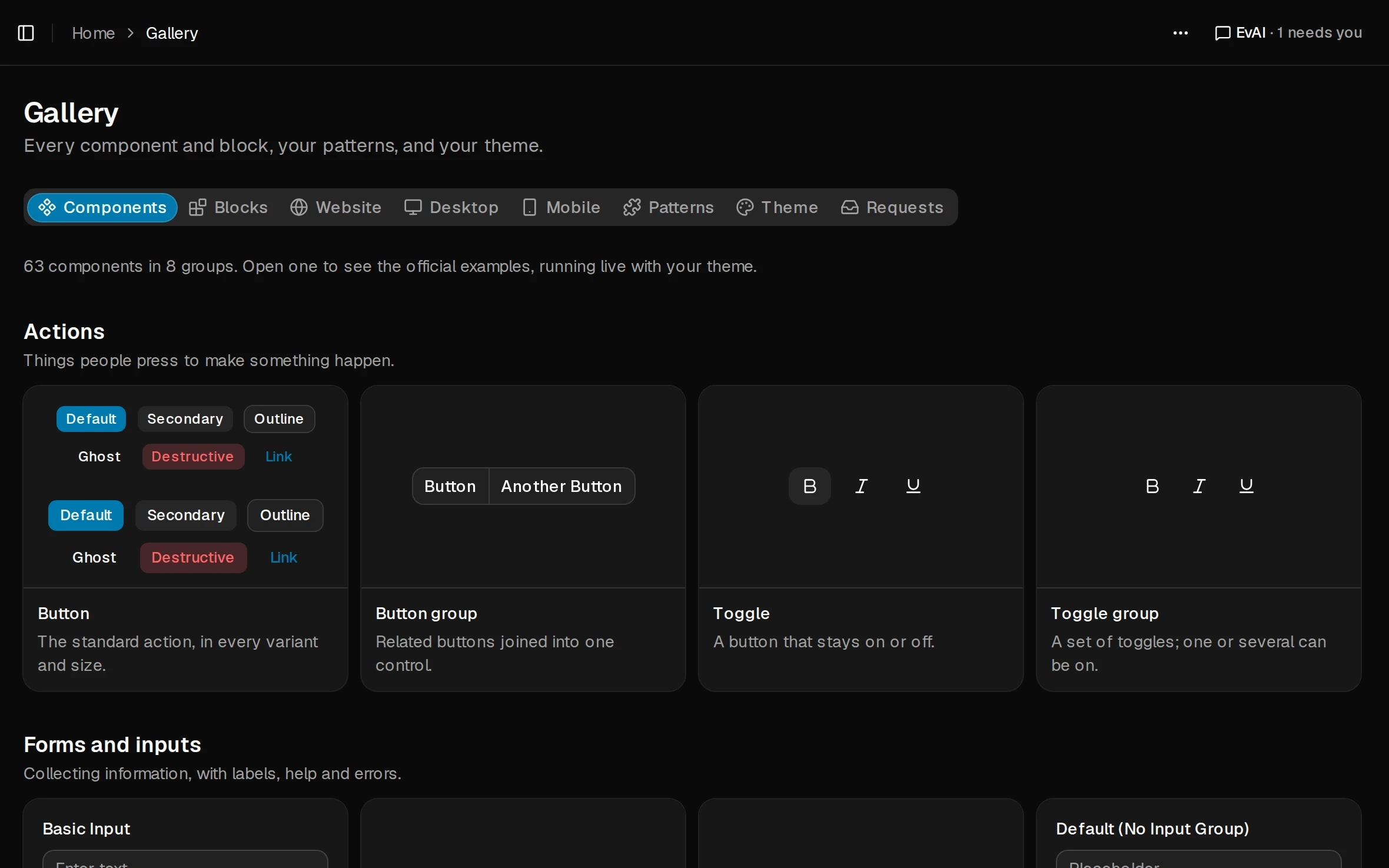
Components, running live in the chosen theme.
First product: Legal
The first product built with Studio is Legal: a private workspace where small business teams upload a contract, understand it in plain English, see the risks, negotiate changes, and never miss an obligation after signing.
- 20 milestones, 14 screens and over 100 designed states.
- Verify: 80 of 80 brief checks, 5 of 5 user journeys, 8 of 8 safety checks and 20 of 20 accessibility checks.
- Now in Review, ready for its two sign-offs.
What I learned
Most of the mistakes that mattered were found by a person using the product, not by an automated check. So the job became turning each of those finds into a check, and the product got better every round.